 |
Carba-Tec Brisbane To change stores please .
|
|
|
|
|
|
|
|
|
| Home |
TRI-TRA001B Triton Router Review
Triton has directly addressed the difficulties
in using a product upside down that has been primarily designed to be
used right side up. The Triton
TRI-TRA001B Router fulfils its design brief and really adds something
special to your workshop.I use a shop-made router table to cut a lot of
my joinery but I have never been entirely happy with any of the routers
that I have fitted to it. They were all good quality, but they were primarily
designed to be used upright or hand-held. Using them in a table always
involved a good deal of hassle when changing bits and when precision was
needed in the set-up of particular cutters. However, you work with what
you have and make allowances for its shortcomings. Until now!
I have been testing the Triton TRI-TRA001B in the
Triton Router Table System and am quite in awe of its features. I
can't believe what I have been missing out on. It is obviously designed
primarily to be used in a router table and solves most of the age-old
problems associated with this. To begin with, the cooling vents are side-mounted
to reduce the amount of sawdust that falls into the powerful 2400 watts
(3-1/4hp) motor. There is no sign of the motor wavering at all under load.
It has a soft start and electronic variable speed that ranges between
8,000-21,000 RPM. This means router bits of all sizes can be safely used.
It's important to remember that large diameter router bits such as panel
raising bits or lock mitre bits should always be used in a router table
and on a slower speed setting. There are two removable collets (one 1/4"
and one 1/4"), so there is no need to use spacer collets unless you
want to use 8mm router bits such as Leigh make.
One of the best features of the TRI-TRA001B is its Dual Mode operation.
A push of a button allows you to operate it as a standard plunge router
when using it hand-held, or a fixed base router with a hand cranked rack
and pinion height adjustment when table mounted. The plunge spring can
be easily removed to allow effortless and smooth height adjustment either
with a crank handle extension arm that comes through the table top for
easy access or with the micro-adjust knob. |
|
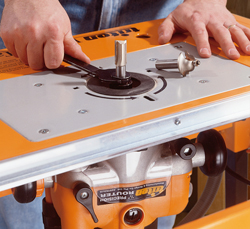
Gone are the days of having
to be a contortionist to set your router bit to the correct height. Changing
router bits couldn't be easier. When the crank handle is turned all the
way home a spindle lock is engaged. The router collet protrudes through
the top allowing easy access with the spanner to change the bits. There
is an added safety feature that ensures the spindle lock can only be engaged
when the safety cover is over the switch and this will only work when
the router is switched off. This safety feature also prevents the router
from being switched back on while the spindle is locked. Because spanner
access is from the base and not the side of the router there is a highly
effective blade guard system and dust extraction outlet, not just the
token attempt that you often see that still needs to allow side access.
This does not however, obscure visibility when using the router in an
upright position.
The fence is a triumph although on first sight this may not be the impression
that one gets. It consists of two components, a large plate that is attached
to the router base plate via two spring-loaded pins that slide positively
into keyhole slots. The fence itself connects to this plate. What I like
a lot about this system is the enormous amount of surface area and support
it gives you. It is perfect for large area hand-held work such as cutting
rebates, trenches or sliding dovetails in panels. The weight of the router
works with you to keep it stable and flat and the soft start reduces the
chance of kickback or catching the material. The plate also gives you
a nice safe position to place your hand for stabilising and supporting
your router when working close to an edge.
Being a router of considerable size and weight, the Triton TRI-TRA001B
may prove to be a little heavy for some dovetail jigs that require you
to hand hold it and move it across the top the comb. If you are using
a Leigh jig, the Vacuum and Router Support will compensate for the weight
and size, giving you much more stability. The KL-15 dovetail jig would
be best used upside down on your router table as the comb is fairly narrow.
If you are going to fit this router to a router table, consider going
for the Triton Precision Router Table System.
|
|
|
Click
here to see pricing on the Triton TRI-TRA001B Router
| |