|
I finally retired from work to take up a life of indolence. I had to do something with my time, so this is how I began working my way through building the classic styles/designs of spearguns. Many of the designs were developed as a consequence of advances in plastic and metal technologies, so it's a real challenge nutting out how to duplicate the designs in wood.
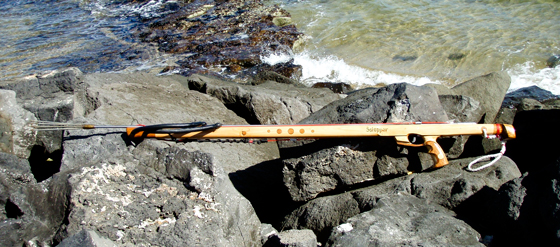
These are real working spearguns, built to take fish and withstand the hurly burly of freediving and spearfishing. I might be getting old on the outside but there is still a 19 year old on the inside that delights in the thrill of the chase.
I learned the basics of woodwork back in the 1960s, but my skill level needed improvement. My joints were less than precise, and the glue-lines were too thick and variable. I joined the Wonthaggi Woodcrafters where I benefitted from the fellowship and skills of the other members. I also did a stint with the Melbourne School of Fine Woodworking.
My joints are now much better (the wooden ones that is - I wish I could say the same about the ones on my skeleton). Mr. Scott-Young would have approved.
I don't have much of a workshop, I use my garage at my coastal Victorian house and the garage at my partner's house in Melbourne. I do most of my work on a table on the front veranda. It's solid and weighty, and the top is soft pine that won't mark or dent my work-pieces. I have a power drill, a power planer, a hand held router, and of course - like just about every other household in Australia - I have a Triton saw bench, but I prefer to use hand tools wherever I can (the neighbours approve too). The local kids tell me I use the same tools used in Lord of the Rings. They think it's great.
Spearguns have several key components. The stock is the backbone of the gun, and it has to be dead straight. My normal practice is to glue-up stocks from paired laminates (paired to balance stresses and ensure the stock timber doesn't move). Once the laminates have been ripped and left to readjust to their new shape, I flatten and smooth them with my #6 Veritas plane. I glue and clamp them to a straight form, and nowadays the glue-lines are gratifyingly slim and even.
I square glued-up stocks using the same plane, but I use a high angle Lie Nielson block plane for more detailed shaping. Epoxy is hard stuff and it takes a toll on plane blades. They need frequent sharpening, so I now use a Veritas guide and waterstones. It's faster and more accurate than the techniques I used in my youth and it puts a better edge on the blades too.
As far as timber goes, some people will tell you that there are three timbers suitable for spearguns: Teak, Teak and Teak. I don't entirely agree. Timbers with a maritime tradition, such as Teak and Huon Pine, have a great wow factor and are lovely to work with, but the right stick of more common timbers can be just as functional and just as decorative, especially if they are appropriately sealed.
I use Tasmanian Oak, Douglas Fir, and even Radiata Pine. The key requirement for speargun stocks is that the timber must be formed straight and stay straight - even if its water content varies - so this requires straight grain. Timber in handles and end-pieces can have a more interesting figure. Density affects buoyancy, and that needs to be taken into account.
Speargun handles are designed to be ergonomically matched to the human hand. First, I cut them out with a coping saw, and then I shape them using the same wood rasp I used more than half a century ago. I do finer work with a Microplane, and then go on to sanding.
I undertake commissions from time to time, but they are not really a commercial activity, especially not if you take time into account. It's the challenge that interests me.
|